Friday, 10 December 2010

Research - Opening scenes


Opening scene of The Grudge

For this task we had to do some research on different opening scenes of the genre that we wanted to use in our main task. I chose to do horror therefore decided to do my research on the opening scene of the movie The Grudge. The film was listed in three genres; horror, thriller and mystery with horror being the main one and the most important.

The opening scene started off with some steady music in the background which sounded quite chilling but also was building us suspense. It was a black background which made the opening more dark and sinister. Slowly came the quote “when somewhere dies in the grip of a powerful rage… A curse is born” this is basically an overview of the whole film. The word curse is then coloured in red with the rest of the words fading out. This suggests to the audience that the whole outline of the film is about this curse that we know is going to be involved because it was specifically highlighted on. This is also projected as a little teaser and again builds up tension right from the start of the film which keeps the audience guessing which wants them to watch ahead. Also two more quotes show steadily after one and the other with the words death and fury highlighted again suggesting to the audience that there’s going to be a lot of deaths and also a lot of anger and rage throughout the film. They are highlighted in the colour red to emphasize the blood and danger. It’s a colour in day to day life used as a warning.

Once the words have vanished there’s a water sound running in the back of the dark coloured background. The audience knows that the location is taken place by an ocean or river type area; this actually lightens the mood slightly. Just then you see a river running and it slowly goes higher from that area and zooms out of it from a close up shot to a medium shot to then a long shot. In this angle shot, we can see that the background is of a typical city life with flats around, people talking continuously and rushing off and you see a building site where it’s making a lot of noise from all the drilling. This sets the mood for the audience; even though quite noisy it’s still the everyday typical life you always see. The audience is calmer at this point of the scene. The camera angle is still a long shot which then goes to a low angle shot where you can see a man standing from a balcony staring down. All the way through this shot the lighting is clear and bright so the audience doesn’t expect any action or any sort of physical violence.


A close up shot of the man’s face shows anxiety and that he’s disturbed about something. It then goes on to show a woman in the bed waking up with a smile on her face and asking the man a question to why he’s a awake so early. Everything seems normal and nothing out of the ordinary is happening which doesn’t make the audience suspect anything or doesn’t build the audience to look out for something to happen. The shots move back and forward from the man and woman whilst she is talking with the man’s expressions not changing and his slow movements. It then shows a medium shot view of the woman looking really relaxed which is the opposite of the man who is still looking quite distressed. She is quite happy and seems cheerful which you can see from her body position which is comfortable and laid back. The lighting in the room is still quite bright where you can see that it’s a bright sunny day suggesting that nothing bad is going to happen yet. However the background is silent whereas before it was noisy but this blocks out everything and you can tell that everything is focused on these two people in the room.
 
With a silent background and all the lighting still the same, it then shows a long shot of the man where you see him slowly turn his face away from the camera showing his back to the audience and him putting his hands on the balcony. There’s a slight pause here for a second where it’s still relaxing and a calm atmosphere but still wanting to know what’s going to happen next. He then drops over the balcony with it still being silent in the background. Birds-eye angle is then used for the next shot where we see that the camera is coming closer and closer to the ground which is supposed to show the man’s point of view which is intense. A close up angle shot of the woman’s face is shown when you hear a thump sound which the audience know is the man landing on the floor without actually seeing it. Right after this sound, the woman’s expression change completely and she gasps. This changes the whole mood of the scene but also the audience’s mood as it happens so unexpectedly. You see her running up to the balcony where her face is shocked and you see her body quite tense and is shivering and taking slow breaths. It then shows a birds-eye angle shot from the woman to the man lying on the floor so that the audience sees what is happening and is a part of the scene.

Its then taken to the bottom from where the body is and a long shot is shown with people around stressing and in shock starting to panic. The sinister music from the start is playing once again. Eye level angle shot of the body on the floor is shown which is slowly zoomed on up to his head where you see blood coming out. Just then you hear a woman whispering which is quite chilling. Music is building up to when the background goes black again.

My Chosen Genre


Horror Genre

I have chosen to do the horror genre. This is because I have researched up on it and looked at many different films in that genre. This has helped me to gain knowledge on how horror films structure themselves so that they are able to keep the audience happy and satisfied with what they have seen. I think that personally horror is one of the easiest genres that you can produce. This is because horror is easier to create as you have to think of one idea and develop that into something scary and also because of the several horror films we have seen in the past, you can develop ideas from them as well and create it in to something original and new. A genre like comedy is difficult to create as you have to keep the audience constantly laughing and smiling so that they feel that it’s a comedy film. Comedy is really hard to manage as the writers have to make sure that the audience will get what they are saying and have to make sure that they will find it funny. Horror films date back to the late 1800’s and early 1900’s, however horror films were not that popular as they weren’t made as much. However over the decades, the popularity of these films have increased and horror films are one of the largest genres ever watched.
Horror movies go a long way back dating back to the late 1800’s where most of them used to be about vampires, monsters and various other creatures. Bloodsucking and vampire bats have always frightened and terrified the audience; these were commonly used by directors. Horror movies are unsettling movies that attempt to draw out the emotions of fear, terror and disgust from their target audience. They often draw out the audience’s fear by building the suspense which places anxiety in their minds which is a common way used by the director to draw out the horror in a more entertaining way so the audience feels involved and pushed to watch more.

Monday, 6 December 2010

Research on BBFC


BBFC - British Board of Film Classification


Before deciding which is our target audience, we had to do some research on the different age groups and what they prefer in a film. Whilst doing this, we found out that certain age groups have limitations on what they can watch and what not. This is decided by the British Board of Film Classification (BBFC) who are not apart of the government but are a independent organisation that are financed and supported by the filming industry within the UK. The BBFC are responsible for organising films and looking over each film individually with them receiving a certificate. Alongside it they have to label information specifying references to violence, any strong language and nudity/sex. Therefore the board also has to clarify a certain age suitable to watch these films and only they are allowed to purchase them.


Suitable for all ages / Universal
When labelled a ‘U’ it usually is understood for all ages to watch, however seeing as anything they see can trouble a child, its put down that these films are suitable from four years and above. Violence, sex or any threatening scenes are not shown so that no significant issues arise which may disturb a child in particular but also adults who may be offended by any discrimination or other issues such as race or sexuality. If any violence or horror do occur in the film, they should be over quickly so that it doesn’t upset a child. They should also know the difference between right and wrong so complex issues can not be put in the film to confuse a child.


Parental guidance
When labelled this, it means that children of any age can watch these movies with or without a adult present. However certain scenes may be unsuitable for a child under the age of 8 so parents are recommended to consider themselves whether they feel if the content will trouble their child. Above the age of 8, the content should not upset a child. Mild bad language is allowed and any violence has to end quickly and also cannot be shown in detail. Discrimination and drugs are not allowed unless it teaches them that it is wrong, dangerous and not tolerated.


Suitable for 12years and over - Cinema only

This was introduced in 2002. This rating is used only for films which are shown in the cinemas. Only the age of 12years and over are allowed to watch these films. However, a child under 12years is allowed to watch these films if accompanied by an adult, who have to be above the age of 18. They are responsible to be with the child whilst the movie is playing. It is solely up to the adult and their judgement, if they would want the child to see the film but it is recommended that they don’t. This is because films under this category may contain mild swear words, mature themes and violence/sex references.


Suitable for 12years and over - Videos and DVDs only
This rating is used only for videos or DVDs which are to be purchased or put as rent. No one under the age of 12 is allowed to purchase or rent a 12 rated film. Unless extra content has been added to the film, 12A films are usually given a certificate to be rated as a 12 when being put onto video. This also includes a game which has been rated a 12. It cannot be bought by someone under the age of 12 and should be accompanied by a adult.


Suitable only for 15years and older

Only people at the age of 15 and above are allowed to view a 15 rated film. This means that they can watch, purchase and rent this film or game by themselves without no adult supervision necessary. No one below this age are allowed to do so. Films rated 15 have the permission to include contents such as strong words, moderate violence/sex references, not detailed sex activity but also hard drugs which is a complex issue.


Suitable only for adults
Only adults are allowed to see this from the age of 18years and over. If rated 18, no one under this age is allowed to see these films in cinema and neither are they allowed to purchase or rent a film/game of this rating. Films rated this have usually no limits to what contents they are allowed to display. This can contain bad language and strong violence/sex reference along with non-detailed sex activity which is also permitted to show. Hard drugs can also be used. However there are still limits on discrimination so no race, religion, sexuality issues are permitted unless created in humorous ways and not directly trying to out them out.

Friday, 26 November 2010

Research - Camera Angles & Shots

Camera angles/shots
Camera angle and shots are used as filming techniques. The director can choose from a range of different types of camera angles and shots as there are several due to each angle and shot showing and representing unique things. Every type of shot and the different angles are always specific and carefully planned out by the directors and producer. Many people get confused and think that camera angles and shots are the same thing where as their purposes are somewhat familiar however are not the same.

Camera angles
Camera angles are as important as the rest of the film making such as the script which is carefully written up with all the details stating what’s going to happen when and who’s going to say what so this, like the script, also has to be carefully picked. Directors use these so that the audience can be involved with the atmosphere around and can be familiar with the relationship between the characters. This is easily done as they help in presenting to the audience the meaning of the film and are able to understand it. A scene can be shot in many different angles; this is done because the director wants the audience to involve in the scene as the angles give out different meanings such as the emotions and the sense of the opposite character.

Eye-level angle
This shot is used so that the audience is on the same position and level as the characters. This angle is very commonly used in most if not all films. This angle is used so that the audience can feel more engaged in the scene and makes them feel as if they are a part of it as it shows the real world in the film. So you can see the atmosphere, the people and the objects around as if you were there in real life, this is so the audience feels comfortable.
Birds-eye view
This angle is shot from directly overhead the subject. This shot is somewhat unusual and is not always noticed by the audience. However this puts the audience in a higher position than the subject so that it seems that they are looking down on the scene. This also again engages the audience as it makes the scene more intense and power-like as the subject below seems less powerful. This angle is mostly used when the director wants the scene to seem more dramatic and tense. It’s also used so that when the director wants the audience to see something that the characters in the film are not aware of or don’t know about it giving the audience the upper hand.

High angle
This angle is shot from above so that the camera is looking down on the character/object making them seem shorter/smaller and also less significant. Also because of where the camera is positioned the subject seems to be wider than it actually is. This angle is also used when there is a level difference between the characters such as when one character is above the other or is stood higher so that it seems that the character below is seen as if less vulnerable and under the other characters control. This is also used to make the scene appear more dramatic and intense.
Low angle
This shot is positioned so that the camera is lower on the vertical axis below the eye-line so that the camera is looking up on the subject. This angle is quite confusing as it may show that the subject is more powerful and is more controlling but it may also show the opposite as its shot from below. More so than ever, the audience is intimidated because the subject seems bigger and more dominant. It seems that audience is looking to them and so is dependant on them in a way.
Over-shoulder shot
This shot is mainly used when there is a ongoing conversation between two characters. The camera is placed over the shoulder of the character seeing part of their head and maybe their shoulder. This is so that you can see the opposite character as if you were looking from that characters point of view seeing what they are seeing. This is also used so that whilst the character is talking you can see what and how they are saying it. Sometimes it’s the other way around so that the camera is placed over the character talking and you can see the opposite’s facial expressions and their reactions to what is being said to them.
Over-shoulder shot reverse
This is basically the same as over shoulder shot but its going back and forward between two characters showing both of their faces whilst the other is talking but also when the character is talking him/herself. This shot is mainly used in dialogue but can be used otherwise.

Camera shots
A camera shot is how much you can see in one frame. These are used so that you can see a particular part of the scene from different aspects. They are very useful in understanding the film and so because of this, they are very important. They show what you can’t see in any other situation. 
Extreme close-up
This is when the directors want to focus on one specific thing in particular. In this shot you can see the subject very closely and in detail such as if they wanted to focus on a characters eye because it showed emotion. This magnifies what the human eye can’t see. This is used when the director wants to show something in a dramatic way so that you can understand more in what’s happening. This is however too close to show a person’s reaction and emotions but it does emphasise in specific detail in one thing.
Close-up
This shows very little and again concentrates on a subject however you can see more such as a face so you can see the reactions and emotions on their face. Because the way its done, the object seems bigger than it actually is as its magnified on it so that the audience is focused on just this object. This can be used to show how a character is and make the audience feel more comfortable so that they feel that they know the character.
Medium/mid shot
In this shot you can see more background as well as the object. This is usually used when two people are talking so that the audience can see the body language of the characters. You sometimes see this when action is taken place such as a fighting scene where you see them fight with their hand but also can see their faces showing emotion.
Medium 2 shot
This shot is mainly used when the director wants the audience to see and understand the body language and emotions between two characters so that the audience can understand the relationship between them. We see how they interact with one another and this makes the audience feel as if they know them. You can also see the background around them so this also shows how the characters feel because sometimes their emotions have an impact on the atmosphere around.
Long shot
This is basically real life size image of the atmosphere and the characters/objects and how they are seen from the audience from where they are. This shows everything that is happening so that the audience feels comfortable with what’s happening. In this shot you can see the characters in full human size and even though the audience is aware of the surrounding area, the focus and attention is still on the subjects.
Extreme long shot
This is taken from a far distance and isn’t emphasising on one thing but is showing the atmosphere around as it isn’t detailing on one particular thing. Its generally used as a scene setting to make the audience feel comfortable.

Tuesday, 23 November 2010

Research - Film Openings

                                                Opening scenes in films

In my production, I have to make a two minute film opening and so I researched up on different genres and how they have started their opening scenes. I also have to look up on the films which match my target audience as then I will be able to get knowledge on what my audience will feel attracted to and be able to use these ideas in my film opening. The opening of a film is important as it usually introduces the characters in and sometimes the story as well.

Many films use the opening as a suspense plot scene so that audience will feel intrigued and want to watch more. This has been used mostly in horror films as it builds suspense right from the start. Many directors use the film opening to fiddle around with the opening titles as some like to play them across the opening scene with the film title being at the start. Some films have the opening scene and then the film title popping up when that particular scene has finished and then carry on with the rest of the titles.

I looked at many different films which are from three main genres. This is so that I can have good knowledge on how each genre presents their film openings to their audience. This will also help me choose a genre for my production.

Here are two of the films that I looked at.

Scary Movie (2000) - Directed by Keenen Ivory Wayans
 

    • Black screen with the words ‘Dimension Films’ fading in showing to the audience that its intense and then fades out slowly. Non-diegetic sounds in the background.
    • Introduces the location of where the story is taking place and then introduces the character. Character is a typical blond girl suggesting that she’s going to do something dumb.
    • Female character puts popcorn on the gas and the phone rings setting a relaxing mood.
    • For about 30secs it’s one whole shot where she moves around and talks on the phone still suggesting a relaxed and calm atmosphere.
    • Popcorn is getting bigger suggesting that something big is going to happen.
    • As well as the build up of the suspense, the characters are shown in funny ways so that the comedy is still there.
    • Music starts to build up and then right when the comedy happens it switches.
    • Comedy is kept constant alongside the make believe ‘horror’ in the film in parts such as when she beats up the children and then chooses a banana as a weapon.
    • Her blond side is shown alongside this when she chooses the dumb solutions so keeping the blond stereotype going.
    • Its night which shows the scary effect but because it’s a comedy there are lights on in the background.
    • She then gets stabbed but even that its gruesome but it still shows the humorous side when it shows her fake breast on the knife.
    • This carries on as she is bleeding but then she gets run over by her dad who doesn’t notice.
    • The last 10secs are not funny but has the scary effect where the killer slashes the knife across her but not showing any blood signifying that its not a scary film.
    • The name of the film comes up in front of a black screen in a white colour.


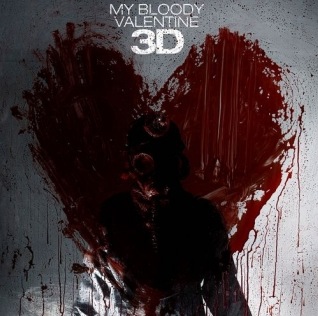
My Bloody Valentine (2009) - Directed by Patrick Lussier
    • Introduces with some dark music and the word ‘Lionsgate’ in a dark red background showing blood which suggests it’s a scary film.
    • Newspaper headline in large font shows up on the screen that says ‘Burned Alive’ putting the tension right in front of the audience
    • Hard music which is creepy but gives an impression that something’s happened.
    • Narrator that sounds like a news reporter talking about the headlines showing up on the screen.
    • Newspapers coming up after one another telling the audience that its breaking news and what has happened is serious.
    • Male actor is introduced by showing his picture showing that he’s the reason behind the bigh news.
    • Bloody helmet is shown and mines suggesting that this is where the big thing happened.
    • Another male character is talked about and is shown with an axe in his hand showing to the audience that he’s going to do something or has done something.
    • All the newspaper headlines are in black and white showing that the incident has already taken place.
    • Big headline says ‘Murder’ in a big large font showing to the audience that the news is murder. Then a axe goes through it showing gruesome effect.
    • Another character is shown suggesting another main actor in the film possibly or who is significant in the film.
    • Last headline say ‘one year later’ which is wear it fades out to a hospital telling us how long its been and where the film is going to start.
    • Dramatic music comes suggesting that something big is going to happen.
    • Production name comes up in a red colour emphasising on the murder and blood.
    • Opening titles slowly fade in, in the colour red as its going to be a horror film.
    • Character lying in bed dreams of a flashback going back to before the big incident which tells the audience on what happen.
    • Man puts mask suggesting that he may survive.
    • Fire comes toward him right to his face and then out of the flashback, he opens his eyes.
    • Eyes are red showing that he’s angry and that he may be bad.
    • Different atmosphere is introduced when a nurse walks in but its silent in the background showing that something is going to happen. She gets worried and scared. Suspense music in the background.
    • Male character is shown sitting down by a man who’s arm is flopping down beside the bed showing to the audience that he’s lifeless and because he’s sitting beside him that he’s the one who killed him.
    • Man gets up and walks towards the nurse.
    • The film title pops up in bloody red suggesting a big massacre. Woman screaming give dark effect that she is dying.
      •  


Monday, 22 November 2010

Preliminary Task - The Review


Preliminary Task

The Review

After seeing the film piece at the end once its been edited, I was pleased with the outcome however not as much I thought I would be. This is due to it turning out to be shorter than we expected and everything is seemed a bit rushed. Before the editing was done, the piece did seem to last longer and made sense. However once the editing had be done, you cannot really tell with what’s going on but can pick up some things as we are talking. This is because as soon as Female #1 walks in it skips straight to her being sat down without even showing the atmosphere which suggests that there is a person in the room or a place to sit. Apart from this, the rest of the clip is satisfying from the camera girls point of view as she was able to get all the angle shots in and from the people acting, we were able to do our part by exchanging some dialogue. We also included opening a door at the start and walking across a room.

The acting from myself and my group member could have been a lot better as it didn’t seem as if were really involved in the conversation. Also you can hardly hear our voices in some parts where you lose what we are saying and the audience is thrown off balance. We could have been able to rectify that mistake by speaking louder and clearly so that the audience would have been able to hear our conversation. From our acting and body language, the audience would easily be able to point many mistakes suggesting that we are not professionals. In my main task, I will make sure that the acting is seen as professional and is perfect so that the audience wont notice and will not be let down. For this to happen, I may have to myself, have to get in lots of practice or get a more skilled performer to act in piece.

We managed to get all the camera angles that we needed and the other specific tasks that were included in the brief. Apart from one of the angle shots which required the camera girl getting a over shoulder shot from an awkward position, they were clearly presented. I wouldn’t change the shots we did as you can clearly see which angle shots were being used. Again these were also a bit rushed and kind of impulsive which didn’t give the audience enough time to get everything in. Out timing of each shots could have been better.

The editing overall was not all bad, however it could have been better as the way it was presented didn’t seem to make sense. Many of the editing cut most of the parts out which were quite significant to the scene. The scene was supposed to be for at least a minute where as ours was only 30seconds due to the many reasons including the editing.

Overall I’m satisfied with the piece as it does fulfil everything that we had to do but I will change a lot of things if I had to do it again as I did learn a lot from this time. Seeing as it was our first attempt, I think we did try our best and learnt a lot so that we know what we have to next time.

Preliminary Task - Main Factors

Preliminary task

Location

In the storyboard that we had chosen to do, the location which was shown on it wasn’t suitable for us to do the filming which was one thing that we had had to change so we decided to pick a place in our school. As we had to the filming in class time, most of the classrooms which suited this piece were occupied as lessons were taking place and the sixth-form area was quite noisy as too many people were in there so we decided to use a place in the drama block. As this place is used for some of our students to use as an social area at lunchtimes, it was perfect for us to use as it had a comfortable relaxed seating area which was quite big. There was also a door which we could use as part of our brief. The lighting was also quite perfect as there was a lot of light coming in and you could see the acting taking place clearly which was also appropriate for the camera.

However if we had to do this piece again, I would want to seat myself somewhere else in the room as because of where I was sitting, the camera girl had difficulty filming the over shoulder shot. This is because behind me was a window which meant that it wasn’t easy for her to place the camera over my shoulder so that you could see the opposite person clearly. Apart from this this, the overall location we chose to do fulfilled the other aspects that we required.


Casting

Female #1 - Aabidah Ali

Female #2 - Safina Rashid

Camerawoman - Jemma

Script writer - Jemma

Producer - Aabidah Ali

Producer - Jemma


Equipment

In this task we had to use some pieces of equipment so that our task could be fulfilled to its best ability. The equipment that we used for this task can/will be used for my main task that I will do once completing this.
The equipment that we used are:

  • A Digital Video Camcorder


    • A Tripod


    • Props (Seating area e.g. chair)


    • A Mac Laptop


    Software

    As part of the brief we have to edit the film piece that we do. Therefore I will be needing a suitable software which will accomplish this for me. Our teacher recommended that we should use to edit our clips iMovie 11 on a Mac laptop. I will be using this software for my main task aswell.
       

      Preliminary Task - What I did

      Preliminary task

      What I did

      I started off with this task by drawing up a storyboard with also my other group members doing one too by looking over the brief that we had received off our teacher. We had to make sure that everything listed in the brief was presented in the storyboard. The brief involved filming a character who is seen opening a door, crossing a room and sitting down opposite another person who they then will exchange some dialogue with. In this piece we also had to use some specific camera angle shots which include over shoulder shot/ over shoulder shot reverse, medium 2 shot and 180 degree rule. Also after filming this piece we had to edit the short scene which was also part of the brief. The storyboards had to be in detail which included estimate time for which each shot would last for and the different angles which will be used for that shot. Because this was out first attempt on this, we didn’t have to put in what the edits would be like, such as the sounds in the background etc because we didn’t know what they would be. I got together with the rest of my group members (Jemma and Aabidah) in class time and looked over each others storyboards. We analysed which storyboard made the most sense and wasn’t too complicated but also bearing in mind that it involved everything that the brief told us to do. In the end we chose to do Jemma’s storyboard which involved the brief and was also able to be done within our group as we only needed two people to do it meaning the third person would do the filming and we could all do the editing in the end together.

      Together in our group we decided that me and Aabidah would do the acting in the piece and that Jemma would do the filming as Jemma was confident in knowing how to shoot the different camera angles where as neither me or Aabidah were. The filming had to be done in two hours of class time which was a reasonable time to do a 2-3minutes of filming and was thought to be too much of a time limit. However this didn’t turn out to be the case as acting wasn’t as easy as we thought it would be. This is due to me and Aabidah laughing constantly and not being able to focus as we have never been filmed before which made it more nerve-racking and was harder on Jemma who was filming. We had to do many of the angle shots again as they went wrong or you could see the giggling on our faces. However in the end, we were able to the filming properly as we had done some shots which were not needed in the film so that we could learn to control ourselves. We started off doing some editing in the last few minutes of our lesson by just giving ideas to each other to what we do but the rest we were supposed to do in our free periods. I was not able to be apart of the editing in the end as I didn’t have the same free periods as Jemma and Aabidah which meant that I would not be able to join them whilst they were editing the piece. After they finished the editing, I was able to see the editing they had done to the piece in class time and was able to give some feedback to them with what I thought was good and what they could have done instead. After reviewing the whole task and getting feedback from the teacher, we then had to put the preliminary task up on our own individual blogs.